Deal teardown 03 · Bridge-to-DSCR exit
How Two Takeout Ceilings Created a $25,053 Payoff Gap
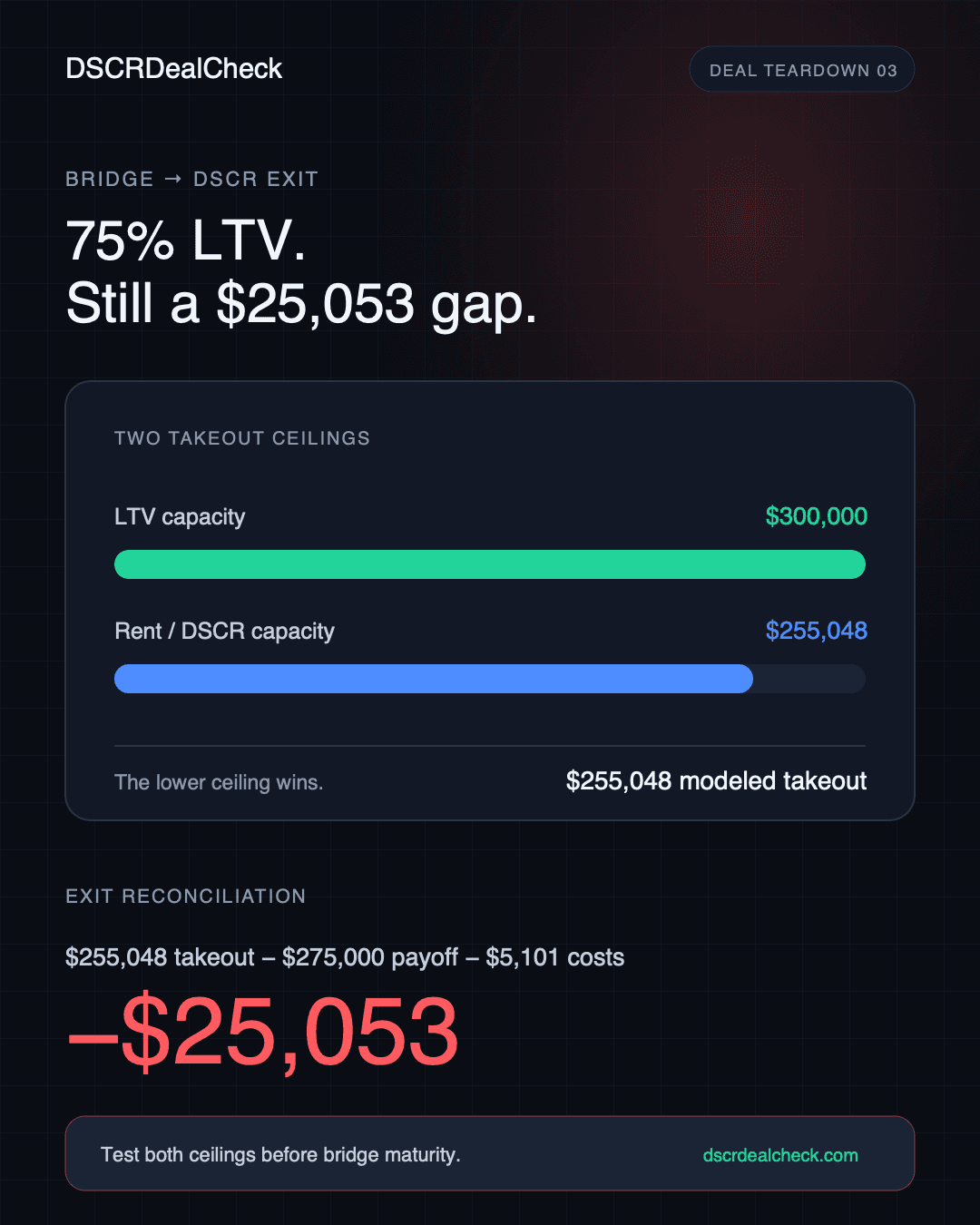
Value supported a $300,000 takeout, but rent coverage supported only $255,048. The lower ceiling controlled the exit.
Published · Educational scenario
Scenario inputs and outputs
The numbers behind the result
- Stabilized value
- $400,000
- 75% LTV ceiling
- $300,000
- Rent / DSCR ceiling
- $255,048
- Modeled takeout
- $255,048
- Bridge payoff
- $275,000
- Estimated payoff gap
- −$25,053
Reconciliation
Controlling takeout
Lower of $300,000 LTV or $255,048 DSCR = $255,048
Exit reconciliation
$255,048 − $275,000 − $5,101 costs = −$25,053
A strong after-repair value does not guarantee a complete bridge payoff. Test both the value ceiling and the rent-supported ceiling before bridge maturity.
The lower ceiling wins
At 75% of a $400,000 stabilized value, the leverage ceiling is $300,000. In the modeled rent, taxes, insurance, rate, term, and target-DSCR scenario, the rent-supported loan is only $255,048. The smaller amount becomes the modeled takeout.
Reconcile takeout against the real payoff
Subtracting the $275,000 bridge payoff and $5,101 of modeled refinance costs from the $255,048 takeout produces a $25,053 shortfall. A date-specific payoff can also include funded draws, accrued interest, extension charges, exit fees, liens, or other items.
- Update the bridge payoff through a realistic refinance closing date.
- Confirm how the takeout provider determines eligible rent and value.
- Stress appraisal, lease-up, rate, taxes, insurance, and timing.
- Plan extension, additional-equity, or sale decisions before maturity—not after a delay.
Treat the refinance as an exit hypothesis
The model identifies a gap; it does not determine available proceeds or approval. A provider still controls value, rent, DSCR, leverage, credit, reserves, seasoning, property, documentation, pricing, and closing conditions.
Run the same check on your deal
Test my bridge-to-DSCR exit
Compare your value ceiling with the loan amount supported by rent, PITIA, target DSCR, rate, and term.
No account or contact details are required to run the calculation. Results are educational estimates, not an approval, commitment, or personalized rate quote.
Frequently asked
Why did LTV support more than the DSCR calculation?
LTV limits debt relative to value, while DSCR limits payment relative to eligible rent and PITIA. In this case, the rent-supported payment produced the smaller loan amount.
Can a higher appraisal eliminate the $25,053 gap?
Not if the rent-and-DSCR ceiling remains lower. A higher value helps only when the LTV ceiling controls. The provider determines both accepted value and eligible rent.
Is the $255,048 takeout a loan approval?
No. It is an educational model using selected assumptions. Provider underwriting and written terms determine the actual loan, costs, eligibility, and timing.
More from the Deal Lab
Method note: this case uses the assumptions displayed above. Real transactions may include different rent treatment, expenses, value, costs, reserves, payoff items, timing, credit, documentation, property rules, pricing, and legal requirements. Verify current written terms directly with the provider and relevant professionals.